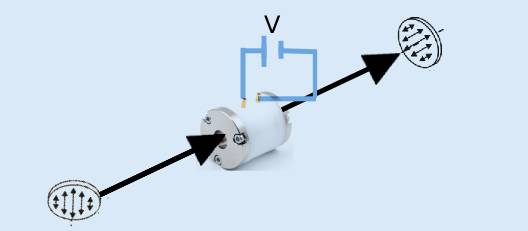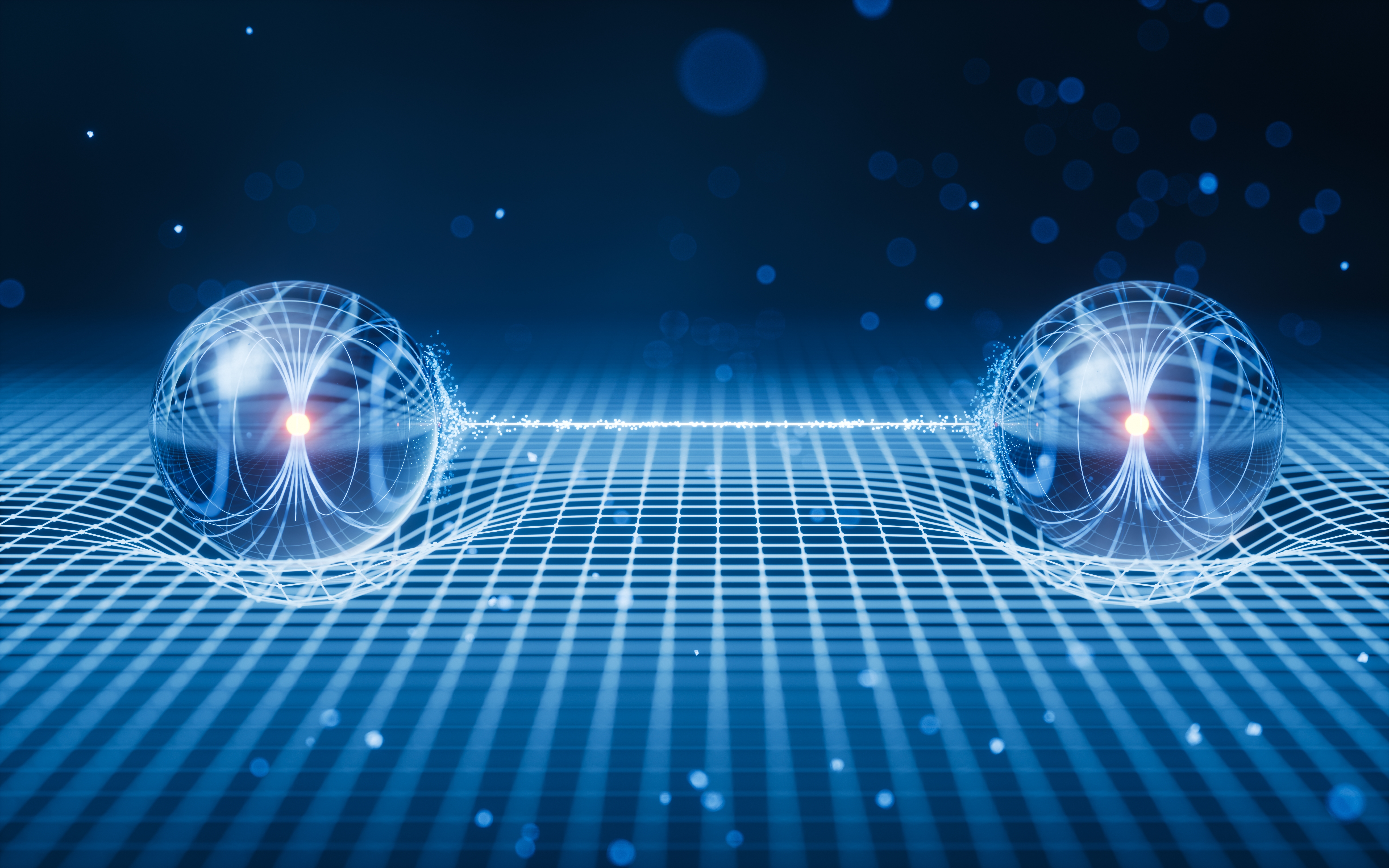
Photonic quantum computation is a quantum computing modality that encodes quantum information directly in the quantum state of light. At face value, light seems like an optimal candidate for encoding quantum information – the high optical frequencies mean we can operate at room temperature, without the need for expensive cooling mechanisms. Furthermore, since photons don’t interact, we don’t need to worry about decoherence and unwanted couplings to the environment.
Unfortunately, every rose has its thorn, and the property that makes photons such perfect carriers for quantum information, makes them suboptimal units for processing quantum information. Unlike matter qubits, which couple strongly through Coulomb interactions, Josephson junctions, or Rydberg blockade, photons just pass through each other essentially undisturbed.
Even the strongest bulk nonlinearities available have negligible cross-sections compared to their losses (it is orders of magnitude more likely to lose photons than to have them interact!), which makes deterministic two-photon gates, the core ingredient of standard quantum computers, completely impossible. This single fact reshapes the whole architecture of photonic quantum computers around entanglement generation, rather than deterministic gate sequences.
Computing with photons
To circumvent this absence of natural optical interactions, Knill, Laflamme, and Milburn (KLM) introduced a paradigm in 2001 that preserved standard gate-based architectures. By routing individual photons through linear beam splitters and conditioning operations on heralded detector measurements, one can implement probabilistic two-qubit gates. However, because linear optical setups can resolve at most two out of four Bell states, gate success rates are fundamentally capped at 50%, with failed trials resulting in total qubit destruction [1]. Although KLM rigorously established that universal optical computation is achievable using purely linear optics and heralded single-photon detection, the monumental resource costs required to attain fault-tolerant thresholds rendered the approach commercially unviable.
Fortunately, a solution soon came. Raussendorf and Briegel proposed a far more radical paradigm shift by completely abandoning the gate-based circuit models standard in matter-based quantum computing. In measurement-based quantum computing (MBQC), processing begins with the generation of an expansive, highly entangled cluster state. The calculation then proceeds exclusively through adaptive single-qubit measurements whose bases depend dynamically on previous detector readings [2]. Of course, there are no free lunches and this does not eliminate the challenge of non-interacting photons, but rather shifts the hurdle upstream. Although the need for inline entangling gates vanishes, the scheme now requires non-deterministic operations in an initial state-generation phase.
Although promising, making these cluster states sufficiently large for quantum computation remains a big challenge. Fusion-based quantum computation (FBQC), formalised in 2023, appeared as a compromise between the gate-based and measurement-based approaches. Instead of synthesizing a single, massive cluster state, systems continuously generate compact, elementary entangled micro-states and stitch them together via probabilistic Bell measurements. These fusion operations act to merge these micro-states into larger states in a robust way [3].
Photons are all you need
Ultimately, KLM, MBQC, and FBQC all rely on a singular foundational prerequisite: the scalable, high-rate production of high-fidelity entangled photon pairs. Modern photonic computing architectures effectively treat entanglement as a consumable fuel, generated abundantly and greedily consumed for information processing.
For this reason, photonic quantum computing lives and dies on the prospect of high rate generation of entangled photon pairs. This imposes stringent requirements on the photonic sources, which must deliver high pair generation rates alongside exceptional photon purity, high interference visibility (such as Hong-Ou-Mandel visibility), and long-term phase stability to operate reliably above fault-tolerance thresholds and support low-overhead fusion operations.
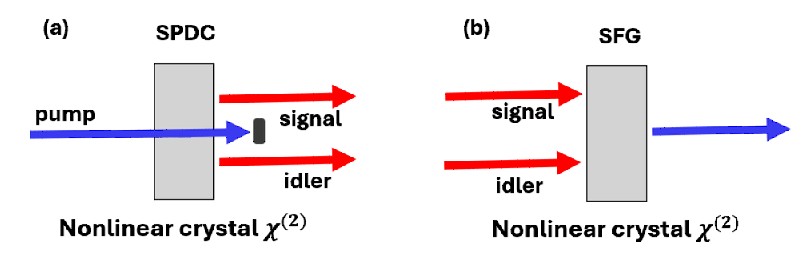
One of the most promising ways of generating photon pairs of that quality is using spontaneous parametric down-conversion (SPDC), currently pursued by industry leaders such as Xanadu and PsiQuantum. In SPDC, a high-energy pump photon passing through a nonlinear crystal spontaneously splits into a pair of lower-energy, highly entangled signal and idler photons, providing a reliable, high-purity source of entangled optical states.
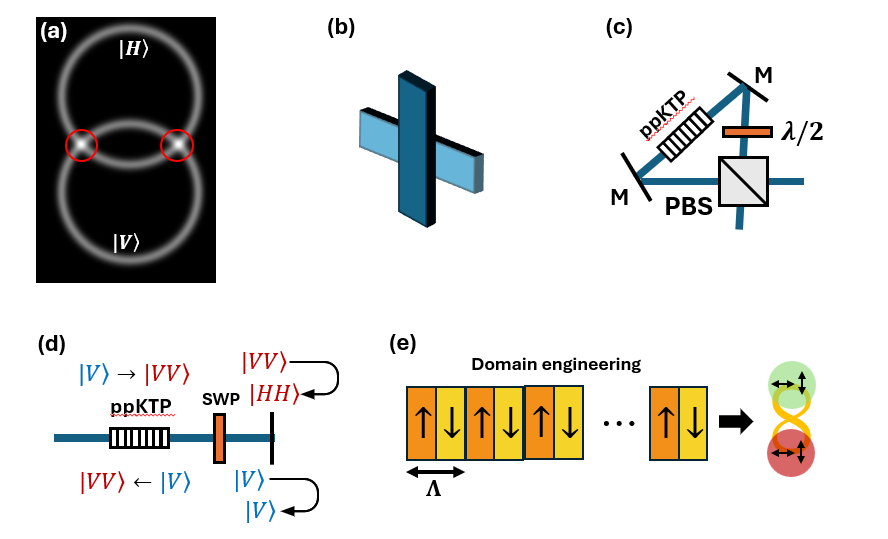
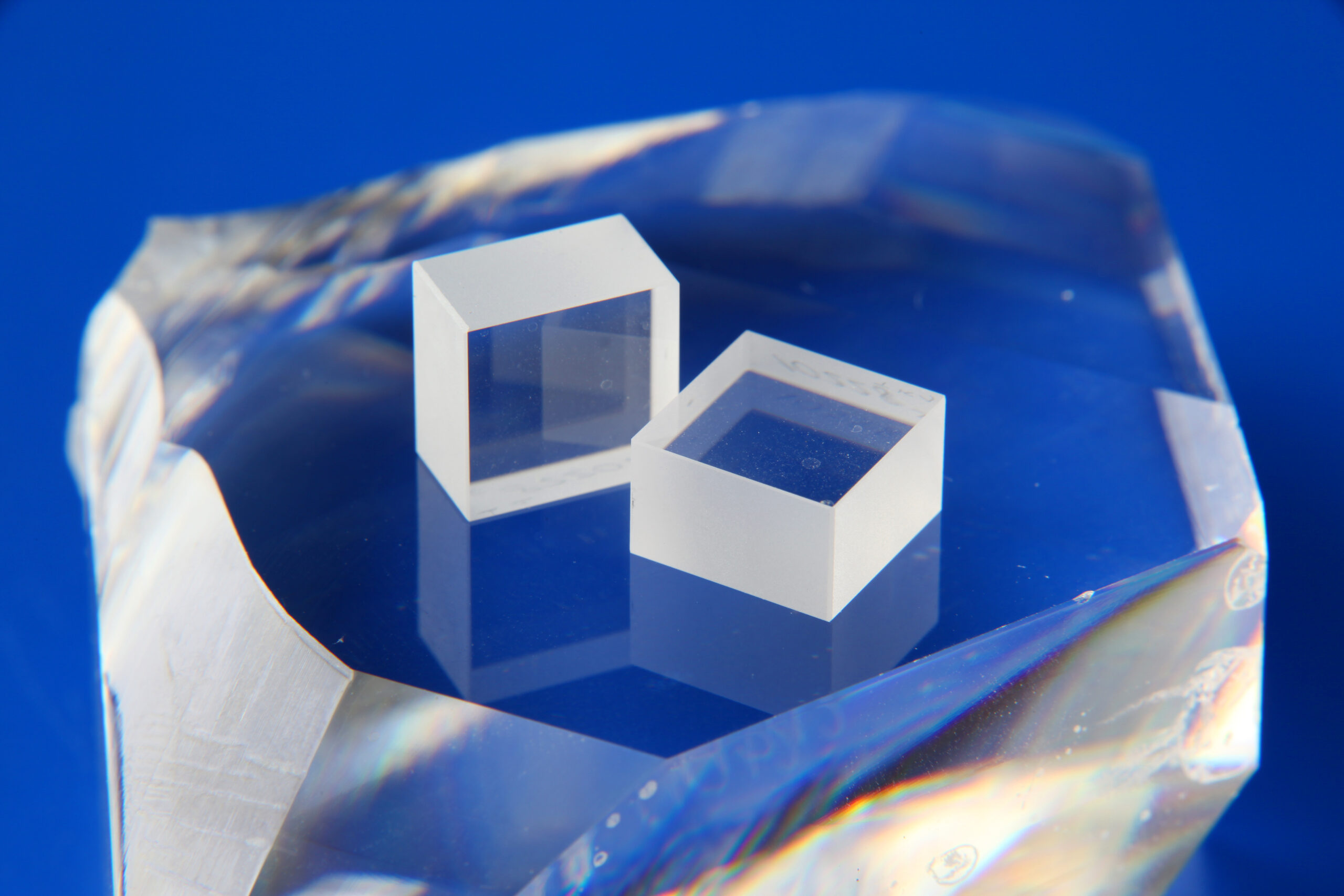
At Raicol, we specialize in high-efficiency ppKTP and custom-designed apKTP (aperiodically poled) crystals engineered for quantum light generation. By leveraging Type-II SPDC and precise spatial apodization, our crystals eliminate residual spectral correlations and sidelobes, natively achieving over 99% spectral purity and high Hong-Ou-Mandel interference visibility straight out of the source—without the need for power-depleting optical filters. This enables exceptionable phase stability and high pair generation rates in a ruggedized, field-ready footprint suitable for real-world deployment. Feel free to reach out to our team to discuss the specifications.
References
[1] Knill, E., Laflamme, R., and Milburn, G. J. “A scheme for efficient quantum computation with linear optics.” Nature 409, no. 6816 (2001): 46–52.
[2] Raussendorf, R., and Briegel, H. J. “A one-way quantum computer.” Physical Review Letters 86, no. 22 (2001): 5188–5191.
[3] Bartolucci, S., Birchall, P., Bombín, H., Cable, H., Dawson, C., Gimeno-Segovia, M., Johnston, E., Kieling, K., Nickerson, N., Pant, M., Pastawski, F., Rudolph, T., and Sparrow, C. “Fusion-based quantum computation.” Nature Communications 14 (2023): 912.
[4] Varnava, M., Browne, D. E., and Rudolph, T. “How good must single photon sources and detectors be for efficient linear optical quantum computation?” Physical Review Letters 100, no. 6 (2008): 060502.
[5] Hong, C. K., Ou, Z. Y., and Mandel, L. “Measurement of subpicosecond time intervals between two photons by interference.” Physical Review Letters 59, no. 18 (1987): 2044–2046.
Have you already subscribed to our YouTube channel? Don’t miss out—subscribe now for exclusive content and updates from our company.