Crystal Selection for Difference Frequency Generation
Difference Frequency Generation offers a robust, solid-state route to coherent and widely tunable mid-infrared radiation without cryogenic cooling. This application note sets out the crystal selection criteria for DFG cavities across Raicol’s quasi-phase-matched portfolio – periodically poled stoichiometric lithium tantalate (ppSLT), MgO:PPLN and ppKTP – and explains where high gray-track resistance KTP belongs in a high-average-power system. All specifications quoted are Raicol catalogue values.
1. Why DFG for the Mid-Infrared
Demand for widely tunable mid-IR sources continues to grow across spectroscopic environmental sensing, defence and security systems, and non-destructive industrial process control. Direct-emitting semiconductor sources in this spectral region are frequently limited in output power and thermal stability, which makes nonlinear parametric conversion an attractive architectural alternative.
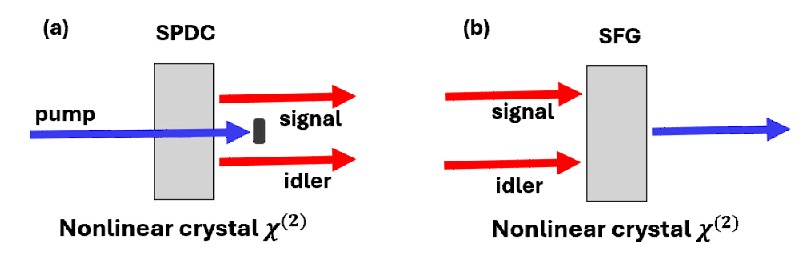
In Difference Frequency Generation, a high-frequency pump at ω₁ and a lower-frequency signal at ω₂ interact within a non-centrosymmetric crystal to generate an idler at the difference frequency:
ω₃ = ω₁ − ω₂ (equivalently 1/λ₃ = 1/λ₁ − 1/λ₂)
For macroscopic energy transfer from the pump and signal fields into the idler, the relative phase velocity of the interacting waves must remain locked over the interaction length. How that condition is met – and what it costs – determines the crystal choice.
2. Quasi-Phase Matching versus Birefringent Phase Matching
In birefringent phase matching, velocity matching relies on crystal anisotropy. This restricts operation to lower effective nonlinear tensor elements and introduces spatial walk-off, which limits the useful interaction length and degrades the output beam quality.
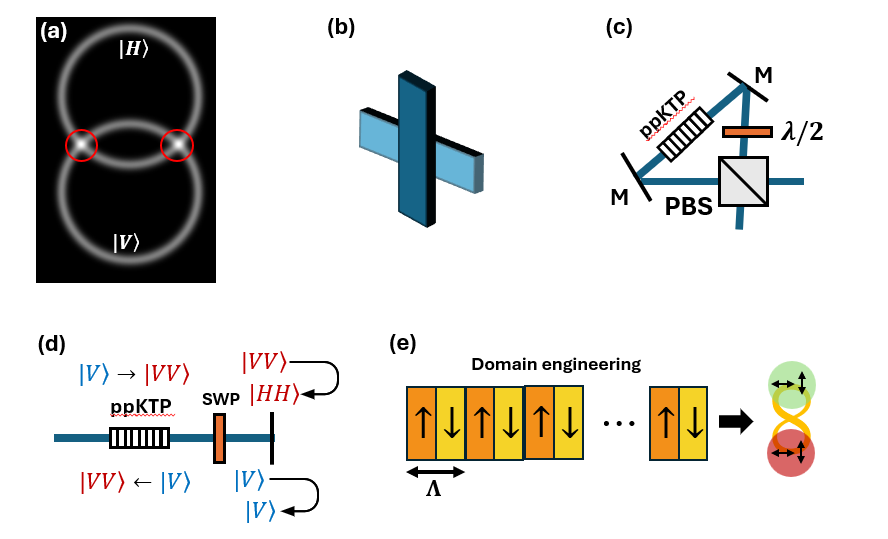
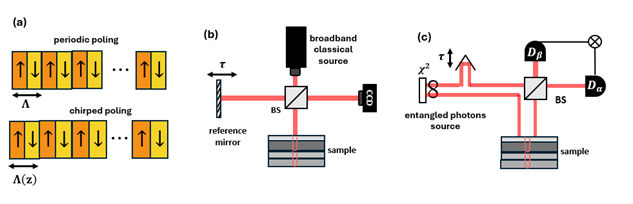
Quasi-phase matching removes both constraints. By periodically inverting the ferroelectric domains with an engineered period Λ, the accumulated phase mismatch is reset before it can reverse the direction of energy flow. Walk-off is eliminated, interaction remains collinear over the full crystal length, and the design is free to access the diagonal element of the nonlinear tensor rather than the weaker off-diagonal terms. The poling period can be engineered during fabrication, so phase matching is set by design rather than by the accident of a crystal’s birefringence.
Figure 1 – spatial walk-off in birefringent phase matching compared with collinear interaction in a periodically poled crystal of domain period Λ.
3. Selecting a QPM Crystal for Mid-IR DFG
ppSLT – periodically poled stoichiometric lithium tantalate
ppSLT is Raicol’s primary QPM material for high-power frequency conversion across an exceptionally broad range, from the ultraviolet to the mid-infrared. Its transparency window of 300–5000 nm covers the full mid-IR band of interest for DFG, and it combines a strong nonlinear coefficient above 7.5 pm/V with high photorefractive damage resistance and excellent thermal conductivity.
The practical consequence is power handling. ppSLT supports more than 10 W of green generation and carries a laser-induced damage threshold of ≥ 570 MW/cm² at 1064 nm, 10 ns, 10 Hz — substantially above MgO:PPLN – which makes it the appropriate choice where the pump is a high-average-power near-IR source and the system cannot tolerate photorefractive lensing.
MgO:PPLN – where nonlinearity dominates
MgO:PPLN offers the highest nonlinear coefficient in the portfolio, with d33 of approximately 27 pm/V, and a transparency range of 420–5200 nm that extends slightly further into the infrared than ppSLT. Its absorption coefficient below 0.1/cm at 1064 nm and compact, integrable geometry suit low- to moderate-power solid-state systems, nonlinear spectroscopy and quantum light sources.
The trade-off is damage threshold. At 100 MW/cm² (1064 nm, 10 ns), MgO:PPLN sits well below ppSLT, so it is best matched to configurations where conversion efficiency per watt matters more than absolute power handling.
ppKTP – broad phase-matching flexibility
ppKTP can be tailored to any nonlinear interaction within the transparency range of KTP, free of the phase-matching limitations of bulk KTP, with an effective nonlinear coefficient roughly three times that of the bulk material. Its transparency of 350–4000 nm covers DFG into the near and lower mid-IR, and it operates near room temperature. With a damage threshold of 600 MW/cm² at 1064 nm for 10 ns pulses and apertures from 1 × 2 up to 2 × 10 mm², it is the most flexible option where the target idler wavelength lies below 4 µm.
4. QPM Specification Comparison
All values below are Raicol catalogue specifications.
Parameter | ppSLT | MgO:PPLN | ppKTP |
Transparency range | 300 – 5000 nm | 420 – 5200 nm | 350 – 4000 nm |
Nonlinear coefficient | > 7.5 pm/V | d33 ≈ 27 pm/V | approx. 3× bulk KTP |
LIDT (1064 nm, 10 ns) | ≥ 570 MW/cm² | 100 MW/cm² | 600 MW/cm² |
Bulk absorption @ 1064 nm | 190 ppm/cm | < 0.1 /cm | See datasheet |
Max length | Up to 40 mm | Up to 40 mm | Up to 30 mm |
Typical aperture | 0.5 × 2 mm | Up to 1 × 5 mm² | 1 × 2 to 2 × 10 mm² |
Photorefractive resistance | High | Relatively high | Near room-temperature operation |
Typical applications | SHG, SFG, DFG, OPO, THG, FHG | Frequency conversion, spectroscopy, quantum sources | SHG, SFG, DFG, OPO, SPDC |
Selection summary: choose ppSLT for high-average-power mid-IR DFG and the broadest transparency; MgO:PPLN where nonlinear efficiency at moderate power is the priority; ppKTP where phase-matching flexibility and aperture options matter and the idler lies below 4 µm.
5. High Average Power: Where HGTR KTP Belongs
A DFG or SHG stage driven at high repetition rate accumulates a different kind of damage from single-shot catastrophic failure. Gray tracks form when a KTP crystal is subjected to high-power, high-repetition-rate pulses or CW irradiation. Induced colour centres absorb broadly across the visible and near infrared, particularly at 532 nm, and because the process is cumulative it progressively degrades harmonic conversion over the life of the system.
Raicol was the first to develop high gray-track resistance flux-grown KTP, enabling higher average power density in SHG across 1000–1400 nm. The distinction matters for system architects: HGTR KTP does not offer a higher peak damage threshold than standard KTP. What it offers is roughly sixteen times the sustainable average power density and an order of magnitude lower gray-track formation – which is what actually determines service life in a continuously operating source.
Parameter | KTP (SHG, OPO) | HGTR KTP |
Max aperture | 40 × 40 mm² | 5 × 5 mm² |
Max length | 40 mm | 15 mm |
Bulk absorption | < 100 ppm/cm @ 1064 nm; < 1000 ppm/cm @ 532 nm | < 50 ppm/cm @ 1064 nm; < 150 ppm/cm @ 532 nm |
Gray tracking (GRIIRA, 600 s) | 2000 ppm/cm | 150 ppm/cm |
LIDT (1064 nm, 10 ns, 10 Hz) | 800 MW/cm² | 600 – 800 MW/cm² |
Average power density | 300 W/cm² @ 1064 nm; 20 W/cm² @ 532 nm | 5000 W/cm² @ 1064 nm; 2500 W/cm² @ 532 nm |
Typical resistivity | 10⁷ Ω·cm | 10¹¹ Ω·cm |
HGTR KTP additionally offers a nonlinear coefficient four times higher than LBO, a broad temperature bandwidth, small walk-off with wide angular acceptance, and non-hygroscopic handling. Average output power density at 532 nm reaches up to 5 kW/cm² depending on the laser regime.
Design boundary: the aperture and length available in HGTR KTP (5 × 5 mm², up to 15 mm) are smaller than in standard KTP (40 × 40 mm², up to 40 mm). Where large-aperture, high-energy beams are the driving requirement rather than sustained average power, standard KTP remains the correct selection.
6. Advanced Poling Architectures
Beyond the choice of material, the poling pattern itself is a design variable. Raicol supplies ppSLT in fan-out, multi-grating, monolithic and chirped configurations:
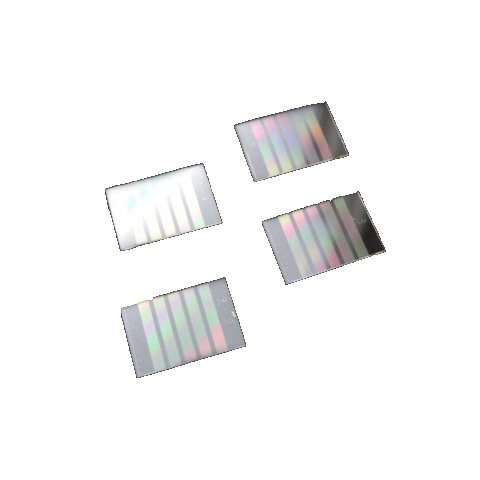
- Multi-grating structures place several poling periods side by side on a single element, allowing the optimum period to be selected by lateral translation rather than by realignment – and enabling high-power THG on a single element.
- Fan-out poling provides continuous tuning for tunable SHG and tunable OPO/OPG, watt-class visible generation, and rapid feasibility testing at new wavelengths.
- Monolithic configurations reduce component count and alignment sensitivity in compact systems.
- ppSLT waveguides, written by femtosecond laser, deliver an order-of-magnitude increase in conversion efficiency with watt-class operation from the UV and visible through to the mid-IR, and a circular output beam.
7. Design Considerations in DFG Cavities
- Specify the poling period against the real operating temperature. A period calculated from a Sellmeier equation without accounting for the actual temperature of the crystal housing will leave residual phase mismatch. Multi-grating elements allow the optimum period to be verified experimentally under real thermal load.
- Design for the thermal gradient, not just the average temperature. Residual absorption under high-average-power pumping produces a radial refractive index gradient, inducing thermal lensing and reducing conversion efficiency even in substrates that resist photorefractive damage. Temperature acceptance narrows as crystal length increases, so gain and thermal tolerance must be traded against each other deliberately.
- Treat the coating as a first-class failure mode. In nanosecond regimes the optical coating commonly fails before the bulk crystal. Raicol supplies AR/AR, DBAR, TBAR, HR and IBS coatings, including dual-band designs below 0.5% reflectivity, specified against the pump, signal and idler wavelengths of the specific interaction.
- Match the crystal to the power regime, not the peak specification. Peak damage threshold governs short-pulse survival; average power density and gray-track resistance govern service life in continuously operating systems. These are different questions and they can point to different crystals.
8. Engineering Consultation
Raicol’s application engineering team supports optical architects and R&D groups with custom poling period design, aperture and length selection, advanced poling patterns, and coating specification for DFG, OPO and harmonic generation systems. Custom apertures and geometries are available on request. Our experts are ready to help you select the optimal solution for your application. Contact Us.
Further Reading
Fejer, M. M., Magel, G. A., Jundt, D. H., & Byer, R. L. “Quasi-phase-matched second harmonic generation: tuning and tolerances.” IEEE Journal of Quantum Electronics, Vol. 28, Issue 11, pp. 2631–2654 (1992).
Kato, K., & Takaoka, E. “Sellmeier and thermo-optic dispersion formulas for KTP.” Applied Optics, Vol. 41, Issue 24, pp. 5040–5044 (2002).
Specifications quoted throughout are taken from the Raicol product catalogue. Values are typical; guaranteed specifications for a given part number are confirmed at order.
Have you already subscribed to our YouTube channel? Don’t miss out—subscribe now for exclusive content and updates from our company.